
Proof of Personhood on Polkadot: The Future of Decentralized Identity

Key Takeaways
Proof of Personhood protects Web3 from Sybil attacks through decentralized identity verification, where each real person can register only one identity per address.
Polkadot's On-Chain Identity System operates in a decentralized manner with registrars and is more cost-effective than traditional KYC – free via Polka Registry or up to 1 DOT with community verifiers.
People Parachain will become Polkadot's specialized identity hub for governance, DeFi lending, and Sybil-resistant airdrops – with cross-chain integration planned by 2027.
Alternative PoP systems such as Worldcoin (biometrics), Idena (test-based), and Gitcoin Passport (aggregator) offer different approaches with their respective pros and cons.
Practical implementation: You can verify your Polkadot identity in five minutes for free via Polka Registry using an Estonia eID.
Introduction
How can decentralized networks ensure that every user is truly a real person – and not an attacker with hundreds of fake accounts?
This is the central question behind Proof of Personhood (PoP) – and Polkadot has an answer for it.
While traditional identification systems store your data on centralized servers, making them vulnerable to hacks, Polkadot's PoP system functions in a decentralized, more secure way, and remains under your control.
In this guide, you will learn how Polkadot verifies identities in a decentralized manner, why this is fundamentally important for Web3, and how you can build your own on-chain identity in just a few minutes.

What is Proof of Personhood? (Basics)
Definition and Sybil Resistance
Proof of Personhood is a verification system that proves there is a real person behind an on-chain address – not multiple fake accounts belonging to the same attacker.
The central problem that PoP solves is called a Sybil attack: a single attacker creates hundreds or thousands of fake accounts to secure airdrops, manipulate governance votes, or defraud DeFi lending protocols.
PoP protects decentralized networks through a fundamental rule: 1 human = 1 vote, 1 airdrop, 1 credit limit. This is achieved by verifying your identity (biometrically, through tests, or via social networks), receiving a digital verification certificate, and having your address marked as "human-verified."
This is not new – computer scientist John Douceur described the theoretical problem as early as 2009. However, modern cryptography using zero-knowledge proofs and decentralized networks makes PoP practically feasible – as the Ledger Academy explains.
PoP vs. KYC: Differences Explained
Many confuse Proof of Personhood with Know Your Customer (KYC). There is a fundamental difference:
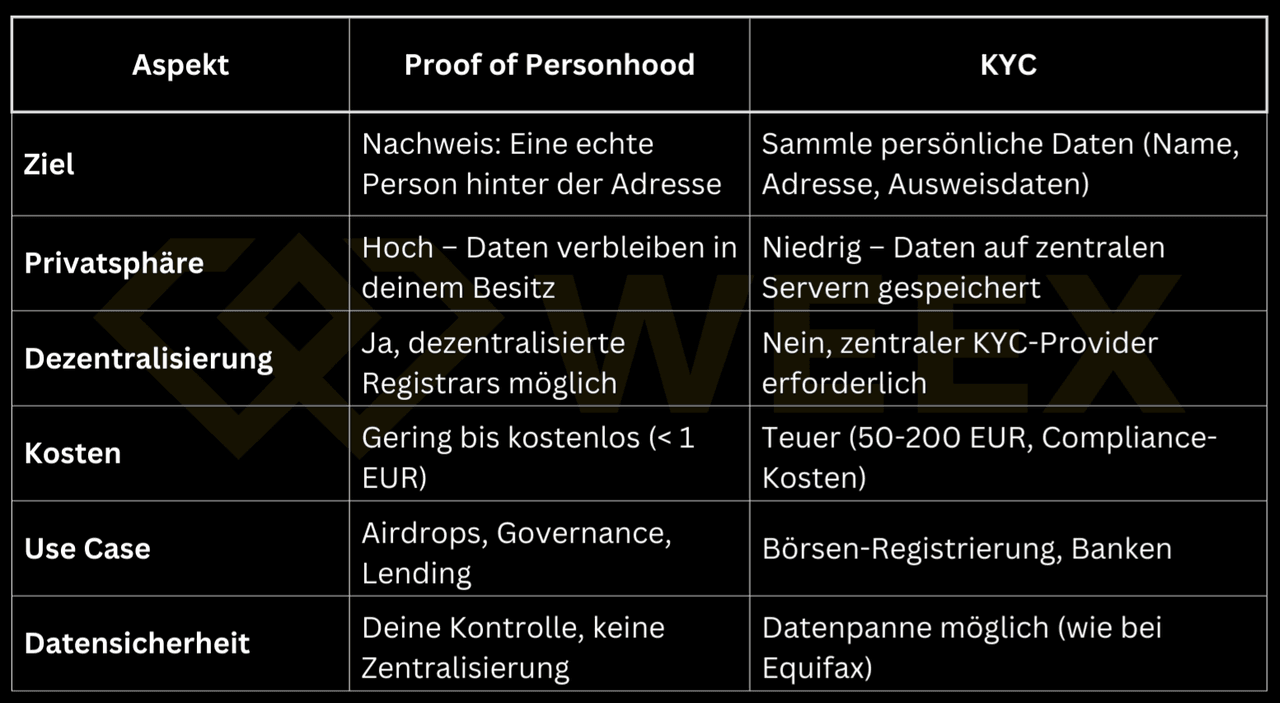
PoP is the Web3-native alternative to traditional KYC – less invasive, more decentralized, and under your control. The Identity Management Institute confirms this distinction based on biometric and zero-knowledge proof methods.
Why Polkadot Needs Proof of Personhood
Polkadot has a unique problem: with OpenGov, DOT holders can vote on the entire future of the blockchain – from network upgrades to treasury distribution.
Without PoP, a wealthy individual could buy 1,000 DOT, distribute them across 1,000 wallets, and manipulate the entire governance process.
With PoP, Polkadot ensures that only real humans can participate in important votes with equal weight. This enables fairer decisions and prevents whale dominance.
Additionally, Polkadot-based projects use PoP for Sybil-resistant airdrops – to avoid losing 99 percent of tokens to bot farms – and for DeFi lending with fair credit allocation, as CoinMarketCap Academy documents.
Buy DOT on WEEX
Polkadot's Proof of Personhood System
On-Chain Identity: How it Works
Polkadot has an integrated on-chain identity system directly in the core code of the Substrate framework. This is fundamentally different from traditional KYC:
Step 1: Register Data
You register data such as a display name, website, email, Twitter/X handle, and a profile picture directly to your Polkadot address. This data is encrypted and decentralized on the blockchain.
Step 2: Registrar Verification
A registrar (a trusted person or organization) manually reviews your data and verifies its authenticity.
Step 3: Verification Status
The registrar sets a status: Unknown (not verified), Reasonable (superficially checked), Known Good (fully verified), or Out of Date (expired).
Step 4: On-Chain Transparency
Your identity is now stored decentralized on the blockchain – transparent, immutable, and visible to the entire network if desired.
Unlike KYC: The data is encrypted and under your control – no central server that can be hacked. The Polkadot-JS Identity Guides show the technical implementation.
People Parachain: Identity Specialization
The People Parachain is Polkadot's newest and most significant innovation – an independent blockchain network that focuses entirely on identity management.
Before: Identity functions were bundled in the Relay Chain and exposed to competing traffic.
Now: The People Parachain handles all identity operations with separate infrastructure and enables:
- Better scalability for identity verifications (fewer delays)
- Specialized on-chain governance for registrars (democratic control)
- Integration with other parachains via XCM (Cross-Chain Messaging)
- Future features such as automated verification and cross-chain DIDs
In the long term, the People Parachain could become a Web3-wide identity hub – not just for Polkadot, but as a standard for other blockchains. Parachains.info documents this development.
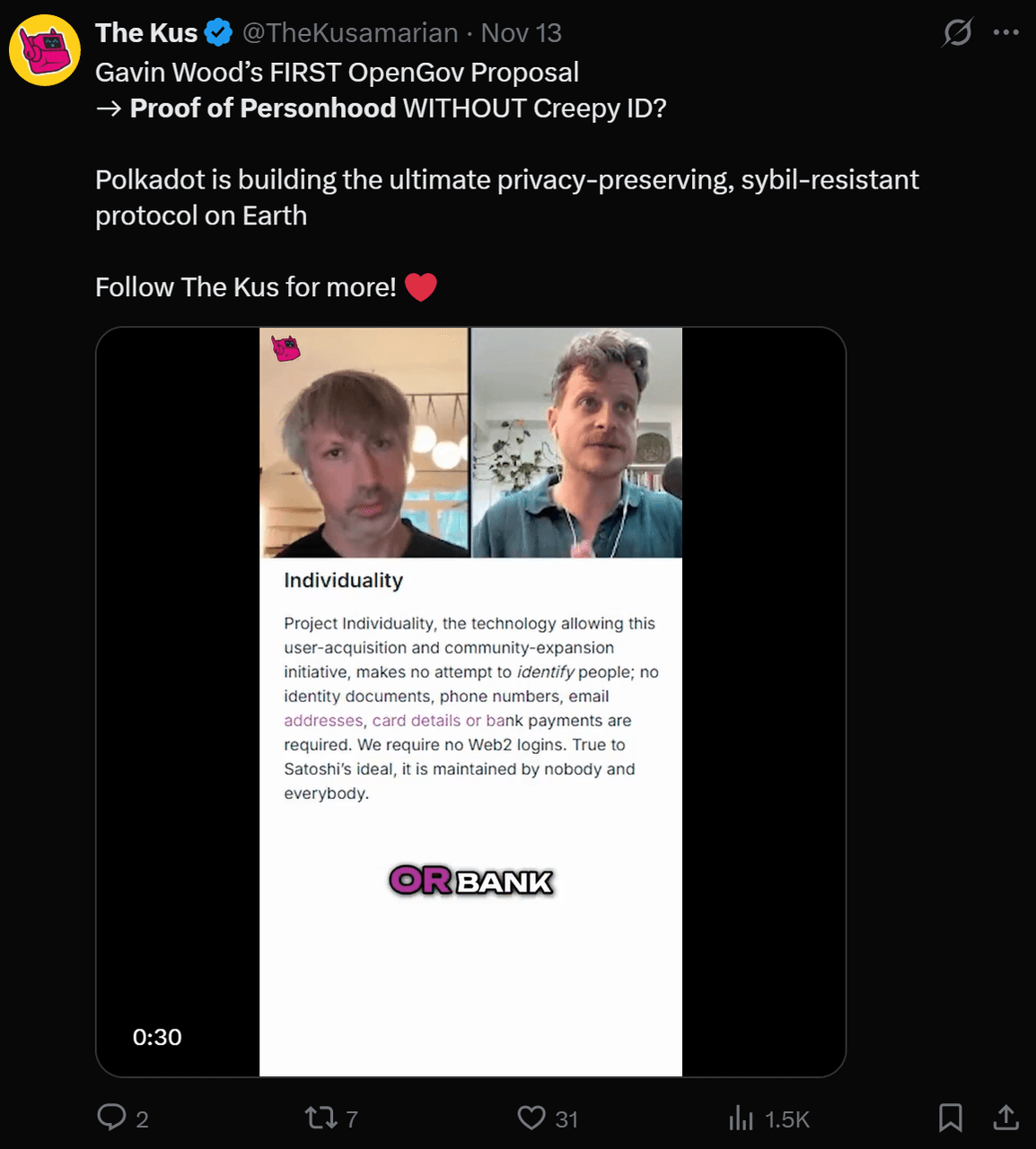
Registrars and Verification
A registrar is the person or organization that verifies your identity – comparable to a notary, but decentralized.
Examples of active registrars:
- Polka Registry: Free verification via Estonia eID or GitHub – based on a decentralized trust network
- PolkaIdentity: Professional KYC integration for enterprise users with compliance requirements
- Community Registrars: Decentralized individuals who agree on Polkadot governance and perform verifications
The system is transparent: every registrar has a public rating, and the community votes on which registrars they trust. This prevents rogue registrars – anyone who cheats is quickly voted out.
Fees and Costs
The costs for identity verification on Polkadot are very low – a major advantage over traditional KYC:
- Polka Registry (free): Via Estonia eID or GitHub – no fees
- Community Registrars: ~0.01 to 1 DOT (~0.10 to 10 EUR) per verification
- Premium Services (PolkaIdentity): ~50 to 500 DOT (500 to 5,000 EUR) for enterprise KYC
For comparison: traditional KYC typically costs 50 to 200 EUR per person. Polkadot's decentralized system is 10 to 1,000 times cheaper and faster.
Other Proof of Personhood Projects in Web3 (Brief Overview)
Polkadot is not alone. Other blockchain projects are developing their own PoP systems in parallel with different approaches:
Worldcoin: Biometric PoP
Worldcoin is the most well-known and controversial PoP provider with 7 million verified users.
How it works: You visit an "Orb" (a scanning kiosk), a device scans your iris and creates a biometric hash (no photo is stored), and you receive a World ID.
Pros: Extremely secure verification – almost impossible to fake or bypass.
Cons: Data privacy concerns regarding iris data collection; regulatory issues – bans in Spain, Portugal, and Argentina. Worldcoin and the Identity Management Institute document these controversies.

Source: X(Twitter)
Idena: Test-based PoP
Idena works completely differently – without biometrics.
How it works: You solve a flip test (CAPTCHA-like tests with images) that only humans can solve correctly. Idena shows you four images, and you must identify which ones have the "natural" sequence.
Pros: Absolutely privacy-friendly, free, decentralized since 2019.
Cons: Can be bypassed by low-wage workers (e.g., Mechanical Turk platforms) – a known security issue.
Idena runs on a 1-person-1-vote blockchain consensus, not on Ethereum or Polkadot.
Gitcoin Passport: Aggregator Model
Gitcoin Passport aggregates multiple PoP providers into a DID Stamps system.
How it works: You connect your existing Web2/Web3 accounts (Twitter, GitHub, ENS, Lens, etc.), receive digital "stamps" as verification marks, and get a Passport trust score.
Pros: Modular and extensible – combines multiple verification layers for more robust Sybil resistance.
Cons: Not as secure as pure biometrics – a hacked GitHub account weakens your Passport.
Comparison to Polkadot: Gitcoin Passport uses external providers and is community-driven. Polkadot focuses on decentralized registrars and is on-chain. Gitcoin Passport Blog explains their system in detail.
Buy Gitcoin on WEEX
Using Polkadot PoP Practically: Step-by-Step Guide
Step 1: Open Polkadot.js and Connect Wallet
Go to Polkadot.js and connect your wallet – whether it's a Ledger hardware wallet, MetaMask, Subwallet, or another Web3 wallet.
Polkadot.js is the official interface for the Polkadot network – fully open-source and maintained by the Polkadot Foundation.
Step 2: Navigate to the Identity Section
- Click on: Developer → Extrinsics
- Select your account
- Select: identity → setIdentity
Step 3: Enter Your Personal Data
Fill in the optional fields:
- Display Name: Your public name on Polkadot (e.g., "Max Mueller" or project name)
- Website: Your personal or project website (optional)
- Email: Your email address (optional)
- Twitter/X Handle: Your social media account (optional)
- Image: IPFS link to a profile picture (optional)
Important: All fields except Display Name are optional. You need at least one entry.
Step 4: Pay Fees and Confirm Transaction
Registration costs about 0.01 DOT (~0.10 EUR). Confirm the transaction with your wallet.
Your identity is now registered on-chain with the status Verification: Unknown – but you have not yet been verified by a registrar.
Step 5: Get Verified by a Registrar
Option 1: Polka Registry (free, recommended for beginners)
- Go to Polka Registry
- Connect your Polkadot wallet
- Select: Estonia eID or GitHub verification
- Follow the instructions (approx. 2-3 minutes)
- Wait 1-3 days for confirmation
After confirmation, you will receive a status such as Known Good or Reasonable.
Option 2: Community Registrars
- Search for active registrars in the Polkadot Discord or Polkadot.org forum
- Contact a registrar and ask about their requirements and fees
- Submit your verification data (typically: screenshot of existing identity like LinkedIn)
- Pay the small fee (usually < 1 DOT)
- Wait for confirmation and the registrar will set your status
The official PolkAssembly support documentation shows further details for advanced users.
Governance Participation with Verified Identity
With a verified identity, you can now participate in Polkadot governance:
- OpenGov votes: Vote on DOT holder proposals with increased trust
- Referendum: Decide with others on network upgrades and critical decisions
- Council Candidacy: Run for the Polkadot Council – your identity increases your credibility
Your identity becomes visible to the community and increases your trust and influence in votes.
Use Cases and Future
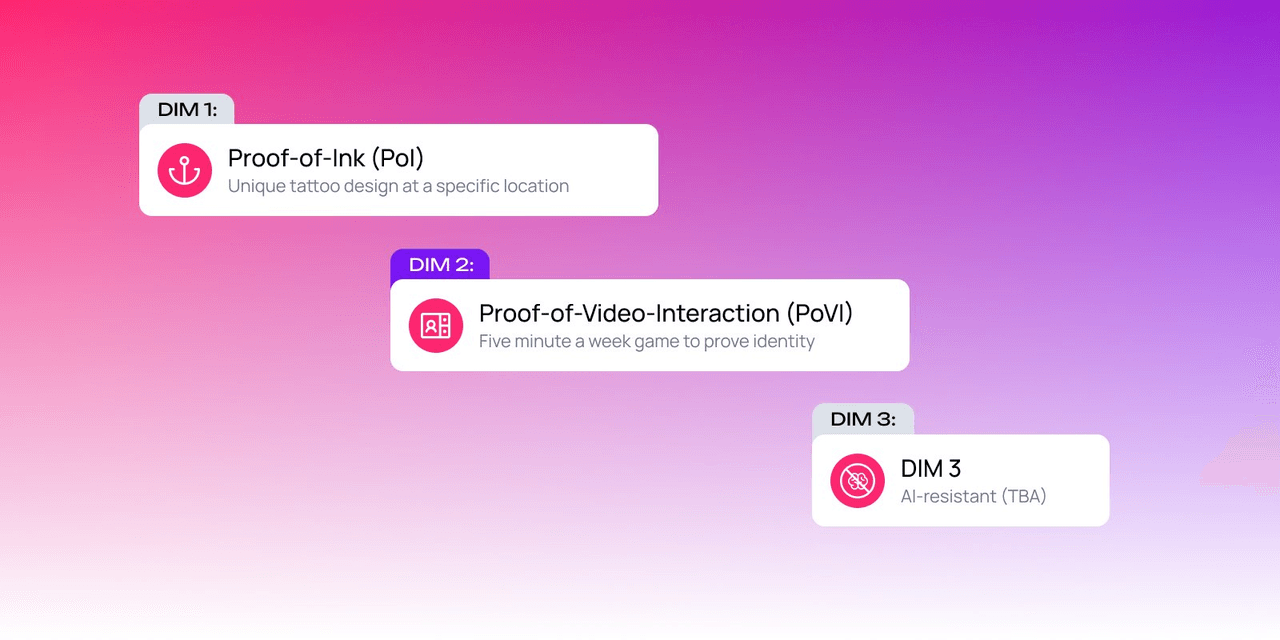
DeFi and Decentralized Lending
PoP is revolutionizing decentralized lending: instead of cumbersome KYC with 50-page forms, you only need a verified on-chain identity.
Practical scenario: A DeFi protocol on Polkadot offers microloans. With PoP verification, you don't need to submit thousands of pieces of personal data. The lender sees: you are a verified person, your on-chain history is clean, your credit score is good → loan approved in minutes.
This reduces fraud cases by 80-90 percent compared to anonymous lending and makes lending possible for unbanked millions of people in developing countries.
DAO Governance and Fair Voting
DAO problem without PoP: With "1 wallet = 1 vote," a wealthy individual with 10,000 tokens can make DAO decisions alone, while 1,000 normal users with 1 token each are marginalized.
PoP solution: With PoP verification, a DAO implements a governance model: "1 verified person = 1 vote," regardless of token count. This makes DAOs more democratic and fairer.
Polkadot itself already uses this in OpenGov – votes are transparent and rely on verified identities for credibility.
Sybil-Resistant Airdrops and Fair Token Distribution
Classic problem: 1 million tokens for an airdrop, 10 million farmers with fake accounts fighting for them. Result: 99 percent of tokens go to bots, not real users.
With PoP: The airdrop provider defines: "1 verified person = 1,000 tokens." Sybil attackers cannot simply create 10 fake identities – they would need real biometrics or real social graph connections for each account.
Projects like Gitcoin save millions in wasted tokens, as the Gitcoin Passport Blog documents.
Conclusion: The Future of Decentralized Identity
Proof of Personhood is no longer theory – it is the answer to one of the biggest problems in Web3: how can fairness and security be guaranteed when everyone has access to the network?
Polkadot's on-chain identity system shows a practical path: decentralized, free or cheap, under your control, and transparent. The People Parachain will make this a Web3-wide standard by 2027.
While Worldcoin, Idena, and Gitcoin pursue other approaches, Polkadot's decentralized registrar model is unique – it decentralizes not only trust but also the verification itself.
The future: Web3 will become fairer, more secure, and more accessible to everyone with verified identities. Your Polkadot identity is the first step.
FAQ - Frequently Asked Questions
Is Polkadot Proof of Personhood free?
Partially. Polka Registry is completely free. Community registrars usually charge less than 1 DOT (< 10 EUR). Enterprise services cost 50-500 DOT.
Can I delete my PoP identity?
Yes, at any time. Go to Polkadot.js → Identity → Clear Identity and pay a small transaction fee. Your identity will be deleted immediately.
Can Polkadot PoP hack my real identity?
No. Your biometrics, social proof, or test results are not stored on-chain – only a verification status. Your personal data remains under your control.
Does Polkadot PoP work cross-chain?
Not yet directly on the mainnet. But Gitcoin Passport, Semaphore Protocol, and other bridges are working on standardizing PoP across blockchains. Cross-chain PoP on Polkadot is planned by 2026.
Why should I use PoP if I only HODL and don't do governance?
Governance reputation, access to airdrops, DeFi lending, and upcoming features like verified user profiles in Polkadot apps. In the future, a PoP identity will be a standard feature for Web3 security – comparable to SSL certificates in Web2.
WEEX | Rising Star of Crypto Exchanges in the DACH Region
WEEX combines security, innovation, and community with features for beginners and professionals:
Security & Protection
- 1,000 BTC Protection Fund: Self-funded fund for rapid loss protection in exceptional cases
Trading & Earning
- Auto Earn: Daily automatic USDT earnings without effort
- Copy Trading: Follow elite traders automatically or apply as an elite trader for additional benefits
- WE-Launch: Early access to new projects – exclusive to WEEX users
Benefits & Rewards
- Promotions & Rewards: Trading competitions and special bonuses for active users
- Affiliate Program: Lifetime commissions from new users – details here
- VIP Benefits: Lowest fees, market insights, and personal support for frequent traders
- WXT Token: Fee discounts, airdrops, and exclusive platform benefits
Discover current trends on WEEX Spot and start now: Register now
Disclaimer – Legal Notice from WEEX Exchange
WEEX and its affiliates offer services for the exchange of digital assets, including derivatives and margin trading, only where legal and for eligible users. All content is general information, not financial advice – seek independent advice before trading. Trading cryptocurrencies involves high risk and can lead to a total loss. By using WEEX services, you accept all associated risks and terms. Never invest more than you can afford to lose. Further information can be found in our Terms of Use and in the Risk Disclosure.